Most people shopping for a home theater projector start with the wrong question. They compare resolution numbers, count HDMI ports, and read the copy on the box, then end up with a machine that throws a gray, washed-out rectangle the moment a lamp or an uncovered window enters the room. The first question is not how many pixels the projector can put on screen. It is what your room looks like when you actually watch something: how dark it gets, how big the screen is, how far back the seats sit, and whether anyone else in the house will ever agree to keep the lights off.
Related: Projector Throw Ratio and Screen Size: The Math That Decides Your Room →
Quick answer
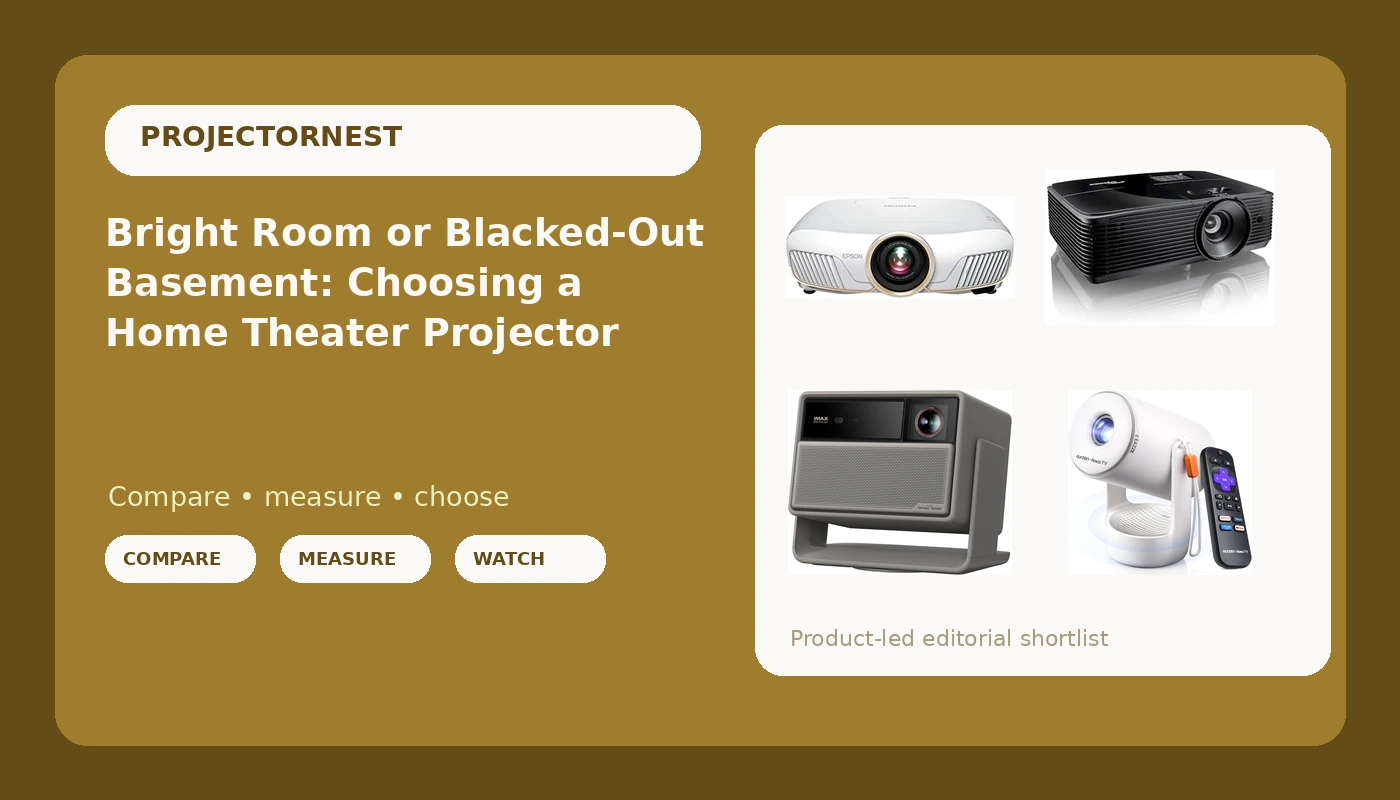
There is no single home theater projector that is right for every room, and the honest answer is that your light control decides more than your budget does. Match the projector class to the room first. A blacked-out dedicated space can justify a three-chip 3LCD model like the Epson Home Cinema 5050UB. A living room with windows you cannot fully defeat calls for a high-output laser model like the XGIMI HORIZON 20 Max. A dark bonus room on a tighter budget is where a native 1080p projector like the Optoma HD146X makes sense, and a portable mini projector like the Aurzen Roku TV E1R covers bedrooms, backyards, and trips. Then check throw distance, screen size, and mounting before you buy anything.
Four useful options
| Model | Best fit | What stands out |
|---|---|---|
| Epson Home Cinema 5050UB | Dedicated, light-controlled theater room | 3-chip 3LCD optical engine with 4K PRO-UHD processing and HDR support |
| XGIMI HORIZON 20 Max | Living rooms with real ambient light | Triple laser light source rated by the manufacturer at 5700 ISO lumens |
| Optoma HD146X | Dark bonus room on a budget | Native 1080p Full HD resolution with no pixel shifting involved |
| Aurzen Roku TV E1R | Bedrooms, backyards, and travel | Built-in Roku TV platform with WiFi and Bluetooth |
The dedicated-room pick: Epson Home Cinema 5050UB 4K PRO-UHD 3-Chip 3LCD Projector with HDR
Here is the trade-off that matters. A three-chip design splits white light into red, green, and blue and sends each color through its own panel, which is why 3LCD projectors tend to hold color brightness as light output rises. The cost is size, weight, and a price bracket that assumes you already have a screen, a mount, and a dark room. If your theater is a converted basement with blackout curtains and controlled lighting, this is the class of projector that rewards that investment. If your room has a wall of west-facing windows and a family that refuses to eat dinner in the dark, this is not the tool for that job, and no amount of calibration fixes physics.
The no-lamp laser pick: XGIMI HORIZON 20 Max 4K Projector Triple Laser Home Theater 5700 ISO Lumens
The pitch here is output and maintenance. A laser light source holds its brightness far longer than a lamp does and does not need a replacement bulb on a schedule, which changes the ownership math over several years. The manufacturer's ISO lumen figure is a rating, not something measured for this article, and ISO lumens and ANSI lumens are not interchangeable labels, so treat the number as a starting point rather than a promise about your wall. What matters practically is that this class of projector is designed for the room most people actually own, one with a window, a lamp, and a hallway light someone forgot to switch off. Put it in a blacked-out theater and you are paying for brightness you do not need.
The budget 1080p pick: Optoma HD146X 1080P Full HD Vibrant Home Theater Projector
Resolution is the least interesting thing about this projector and the most advertised. A native 1080p image on a 100-inch screen at a normal seating distance is genuinely sharp, and the money you do not spend on pixel shifting can go toward a better screen or better blackout curtains. The catch is that 1080p is the ceiling. If your plan is a 120-inch screen in a light-controlled room with 4K sources and a calibration habit, you will outgrow this class quickly. Buy it when the room is dark and the budget is finite, and be honest with yourself about both.
The portable pick: Aurzen Roku TV E1R Smart Portable Mini Projector with WiFi and Bluetooth
Nobody buys this class of projector to replace a theater. You buy it because the kids want a movie on the bedroom wall, because the backyard needs something on a sheet after dark, or because a hotel room has a blank wall and a long evening. The built-in Roku platform means you do not need to bring a streaming stick, and the size means it travels in a bag. The trade-off is the same one that applies to every mini projector: brightness is limited, so ambient light washes the image out fast, and a small chassis leaves less room for the optics and cooling that a fixed installation can accommodate. Used after dark, it does the job it was designed for.
Prices and availability may change. Product images, names, and retailer links are matched to verified listings. No current price, rating, stock status, or measured result is stated here without current evidence.
Lumens are a promise, ANSI lumens are a measurement
Brightness is the number every buyer looks at and the number most likely to mislead. There are at least three different things a manufacturer can call lumens: light source lumens, which describe raw output before the light passes through a color wheel, a lens, and a polarizer; marketing lumens, which are whatever the packaging department decided; and measured lumens, taken under a defined procedure. ANSI lumens are the long-standing standard, measured with the projector set to a specific configuration and averaged across a grid of readings. ISO lumens follow a different published procedure with different allowed settings, which is why a projector can carry an impressive ISO figure and a far more modest ANSI figure without anyone technically lying.
The practical rule is simple. If a brand states ANSI lumens, you have something to compare. If a brand states ISO lumens, you have a number measured under conditions that may not match your room. If a brand states only "lumens" or "light source brightness," you have marketing. Compare only within the same standard, and treat a spec sheet that mixes them as a warning sign.
Room light decides more than resolution does
Contrast is what makes an image look like film instead of a slideshow, and ambient light is what destroys contrast. When stray light hits a screen it lifts the black floor, and every dark scene turns gray. No projector setting recovers that, because the problem is happening at the screen, not inside the projector. This is why a modest projector in a genuinely dark room can look better than a very bright one in a room with a window behind the seats.
You control two levers. The first is the room: blackout curtains, dark paint, no fixtures aimed at the screen, and doors that close. The second is the screen. A matte white screen spreads light evenly and is the safe default in a dark room. An ambient light rejecting screen is designed to reflect projected light back toward the seats while absorbing light arriving from the sides and above, which helps in a room with some stray light, though it narrows the viewing cone and costs more. Neither lever substitutes for the other. Fix the room first, then spend on the screen, then spend on the projector.
How to choose, in five steps
- Measure your room light before you shop. Watch a dark scene on a laptop in the room at the hour you actually watch, and count the light sources you cannot turn off.
- Measure throw distance and screen size. Distance from lens to screen divided by screen width gives your throw ratio, and every projector has a range it must fit inside.
- Decide whether the projector will be permanently mounted or moved. A fixed ceiling install can use a bigger, heavier chassis; a portable has to survive a shelf and a carrying case.
- Choose the light source. Lamps are cheaper up front and need replacement; laser and LED last far longer and cost more to buy.
- Confirm the install details: zoom range, lens shift, keystone correction, fan noise at the seats, and how the projector gets its audio.
Practical guidance before you buy
- Blackout curtains are cheaper than a brighter projector, and they improve every projector you will ever own.
- Sit closer before you buy bigger. A 100-inch image from eight feet is immersive; the same image from fifteen feet is a television.
- Check fan noise at the seating position, not at the projector, since fan noise and brightness usually rise together.
- Plan audio before you buy. Most projectors in this range will not carry a room on their own for a real movie night.
- Buy the screen after the projector is installed and you know the throw distance, not before.
Which option should you choose?
Choose the Epson Home Cinema 5050UB when you have a dedicated, light-controlled room and want a three-chip 3LCD image with 4K PRO-UHD processing and HDR support. Choose the XGIMI HORIZON 20 Max when the room has real ambient light and you would rather not think about lamp replacements. Choose the Optoma HD146X when the room is dark, the budget is finite, and 1080p is enough for your screen size and seating distance. Choose the Aurzen Roku TV E1R when the goal is casual viewing somewhere that is not a theater, from a bedroom wall to a backyard sheet.
A note on evidence: everything above reflects manufacturer-published specifications and product positioning. None of these four projectors were measured for this article, so no independent brightness, contrast, or fan-noise figures are claimed. Brightness numbers that appear in a product name are manufacturer ratings, and the two standards in circulation are not directly comparable.
The bottom line
A home theater projector is a system component, not a purchase you make in isolation. Decide what your room can realistically be, then buy the projector that matches that reality. If you can black out the room, a three-chip 3LCD model like the Epson Home Cinema 5050UB is the class that rewards the effort. If the room stays lit, a high-output triple-laser model like the XGIMI HORIZON 20 Max is built for that fight. If the budget or the room is small, the Optoma HD146X and the Aurzen Roku TV E1R cover the two ends of casual viewing without pretending to be something they are not. Check current Amazon price on each and confirm the throw distance fits your wall before you commit.