Related: Best Projector for a Dark Basement Under $1,000
Most people build a home projector setup backwards. They pick the projector first, chase a lumens number on a box, and then wonder why the picture turns to fog at four in the afternoon. I have spent fifteen years hanging and calibrating projectors, in blacked-out basements and in living rooms with three uncovered windows, and the order that actually works is room first, screen second, projector third.
That order is why this guide has four parts instead of one. Three projectors, each aimed at a different room and a different budget, plus one screen that makes all three of them look better. The screen is the piece people skip, and it is the piece that decides whether your setup looks like a theater or like a laptop taped to a wall.
I do not print prices here, because they move weekly and a stale number helps nobody. Every link goes to the current listing, where you can check the number yourself. What I can tell you is what each product is for, and what it will not do.
Best Overall: XGIMI HORIZON 20 4K RGB Triple Laser Home Projector
This is the projector I would put in a room that deserves one. A triple laser light source means no lamp to replace and no slow dimming curve over a few thousand hours of use. The 4K panel is the real kind of 4K rather than a 1080p chip shifting pixels to fake it, and the manufacturer rates the output at 3200 ISO lumens. ISO lumens and ANSI lumens are not the same measurement, and I get into that below, but 3200 of anything is a serious number for a home projector.
Laser also means instant on and instant off. There is no warm-up, no cool-down, and no waiting for a lamp to come up to color. That matters more than people expect, because it changes how often you actually turn the thing on. A projector that takes ninety seconds to become watchable is a projector you slowly stop using.
The catch is the price. This is the most expensive product in this guide by a wide margin, and it is not close. Check current Amazon price and be honest with yourself about whether your room earns it. If you have light control, a screen, and enough wall, this is the pick that ends the upgrade cycle for a long time. If your room is a bright living room with no curtains, no projector at any price will save you, and the money belongs on window treatments first.
Best Value: ELEPHAS Roku TV Smart Projector with Wi-Fi and Bluetooth
Roku TV built into a projector is a bigger deal than it sounds. There is no streaming stick dangling off the back, no second remote, and no HDMI port slowly loosened by the weight of a dongle. The apps are the apps, the interface is the one millions of people already know how to use, and Wi-Fi and Bluetooth cover streaming and audio.
This is the pick for a bedroom ceiling setup, a dorm room, a small apartment where you cannot drill into anything, or a kids room where one remote and a simple menu are the whole point. It is also the least expensive projector here, which is not the same thing as the cheapest way to get a bad picture.
What it is not is a light cannon. Roku inside does not change physics. Point this at a wall in a room with a window and no blinds, and you will see exactly why I keep saying room first. Put it in a dim room and pair it with the screen further down, and it will look far better than its price suggests.
The Bluetooth is the underrated feature. You can send audio to a soundbar or a pair of headphones with no cable running across the floor. In a bedroom, headphones are the entire feature.
Best for Backyard Nights: HAPPRUN Native 1080P Outdoor Smart Projector with Projector Stand
"Native 1080P" is the two words that matter here. Plenty of budget projectors claim 4K UHD while sitting on a 1080p chip, and that is one of my least favorite things about this industry. Native 1080p is an honest claim, and on a screen that is 100 inches across, honest 1080p looks good.
The included stand is the other reason this one belongs in the guide. Outdoor setups get improvised, and improvised means a projector balanced on a cooler at a bad angle, which means digital correction eating your resolution and your brightness at the same time. A stand means the projector sits where you point it, and the image starts square.
Outdoor projection is a different discipline. You are not fighting a lamp, you are fighting the sky. Wait for full dark, keep the screen away from porch lights and street lamps, and avoid a surface that catches the neighbor's security light. The HAPPRUN is the one I would hand to someone doing their first backyard movie night, because it is built for that job and it arrives with the piece everyone forgets to bring.
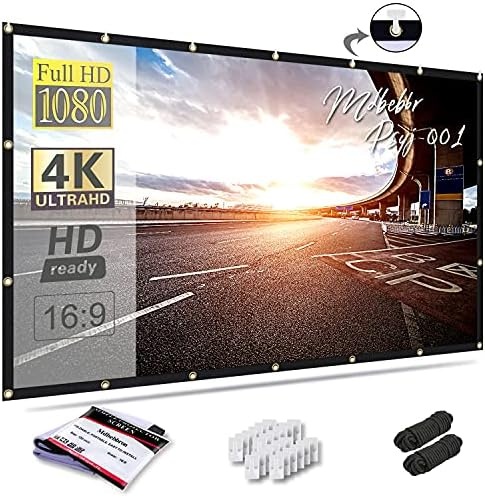
The Screen That Makes the Rest Work: Mdbebbron 120 inch Projector Screen
A 120 inch, 16:9 screen is the single best dollar-for-picture upgrade in this entire guide. A white wall is not a screen. It is a painted surface with texture, a color temperature, and whatever your roller left behind. A screen is a consistent surface with a defined edge, and a defined edge is what makes a projected image look intentional instead of accidental.
This one is foldable, which matters more than the marketing suggests, because a screen you can fold and drop in a closet is a screen you will actually use outdoors instead of leaving it mounted in the basement. Anti-crease construction is the spec to care about there. A crease in a projection surface shows up as a shadow line across someone's face during the one scene where it is least welcome.
It supports double sided projection, so you can hang it in a doorway or between two rooms and project from either side. That sounds like a niche feature until you host a backyard party where half the crowd ends up behind the screen.
At 120 inches diagonal, plan your throw distance before you buy. This is not a small image, and a short-throw projector that cannot fill it will leave you with black bars on all four sides.
How I judge a projector
Four things, in this order.
Brightness, in a measurement the brand will actually name. If a spec sheet says lumens without qualifying them, I assume the number is inflated until proven otherwise. ANSI lumens are the industry standard measurement, and a brand that will not say ANSI is telling you something by staying quiet.
The lens. Zoom and shift are what let you put a projector where it belongs instead of where the picture happens to land. A projector with no lens shift and no zoom forces you to move the furniture, or to correct digitally and throw away pixels you paid for.
Fan noise at full power. A projector is a light source with a heater attached, and the fan is the tax you pay for it. A machine you can hear during quiet dialogue is a machine you will resent by the second act.
And the only test that matters: would I sit through an entire movie on it, in a real room, without reaching for the remote to fix something. Everything else is a spec sheet.
What the specs actually tell you
ISO lumens, ANSI lumens, and "LED lumens" are three different things wearing the same word. ANSI lumens is the standard. ISO lumens is a different method that produces a different number, often a friendlier one. If you are comparing two projectors and one quotes ANSI while the other quotes ISO, you are not comparing anything yet.
Lamp, LED, and laser are the three light sources. Lamps are cheap to buy and expensive to own, with replacement landing somewhere in the low thousands of hours. LED lasts longer and is generally dimmer. Laser lasts longest, turns on instantly, and costs the most up front. There is no free option, only a trade you choose.
Pixel shifting is real. A 1080p chip that shifts fast enough to build a 4K image genuinely produces a sharper image than the same chip standing still. It is not the same as a native 4K panel, and the difference shows up on fine text and film grain. But pixel shifting works, and anyone who calls it a scam has not watched one for an evening.
Throw ratio is the spec nobody reads and everybody needs. It is distance divided by image width. A 120 inch screen is about 105 inches wide, so a projector with a 1.2 throw ratio needs roughly 10.5 feet of distance to fill it. Measure your room before you buy the screen.
Projector and screen reference chart
This is the chart I keep in my own notes. Room first, then the product, then what it needs from you. Every entry links to the current listing, so check the number there rather than trusting one from last month.
| Product | Room it suits | What it brings | Screen to pair | Price |
|---|---|---|---|---|
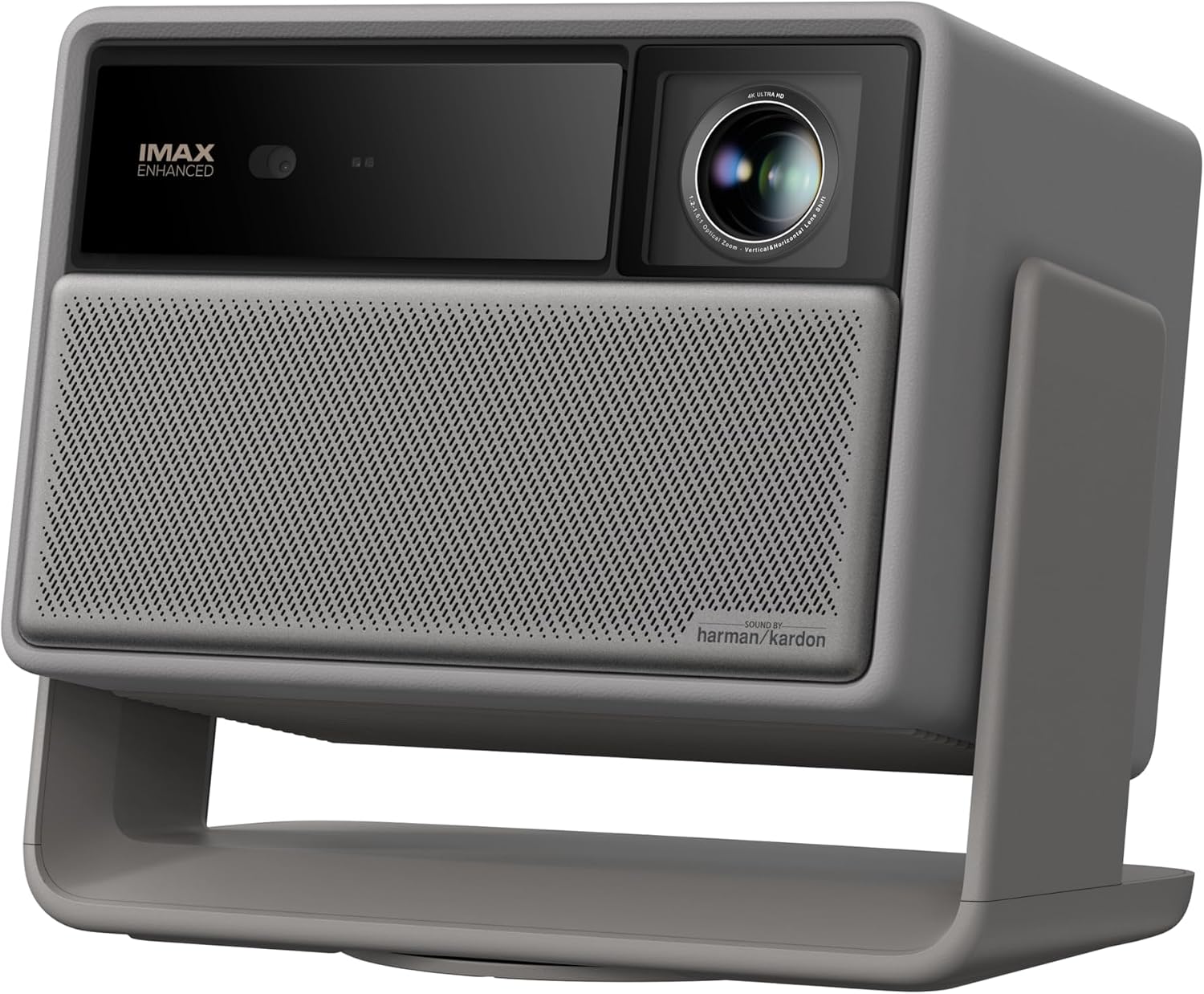 Visit on Amazon → XGIMI HORIZON 20 |
Dark room with real light control | 4K RGB triple laser, 3200 ISO lumens, no lamp | 100 to 120 inch, 16:9 | $1,559.00 |
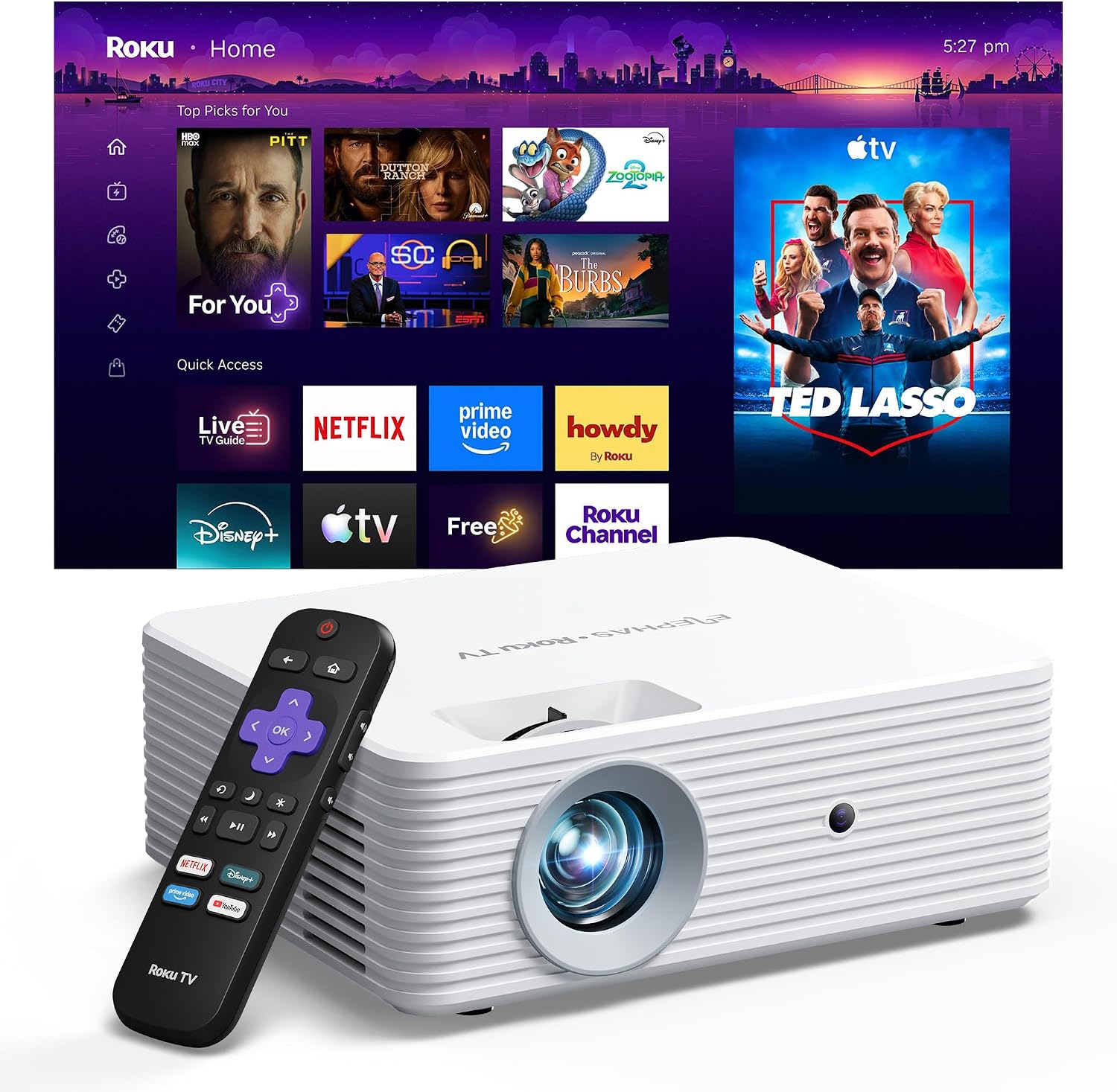 Visit on Amazon → ELEPHAS Roku TV Smart Projector |
Bedroom, dorm, dim apartment | Roku TV built in, Wi-Fi, Bluetooth audio | 80 to 120 inch, 16:9 | $89.99 |
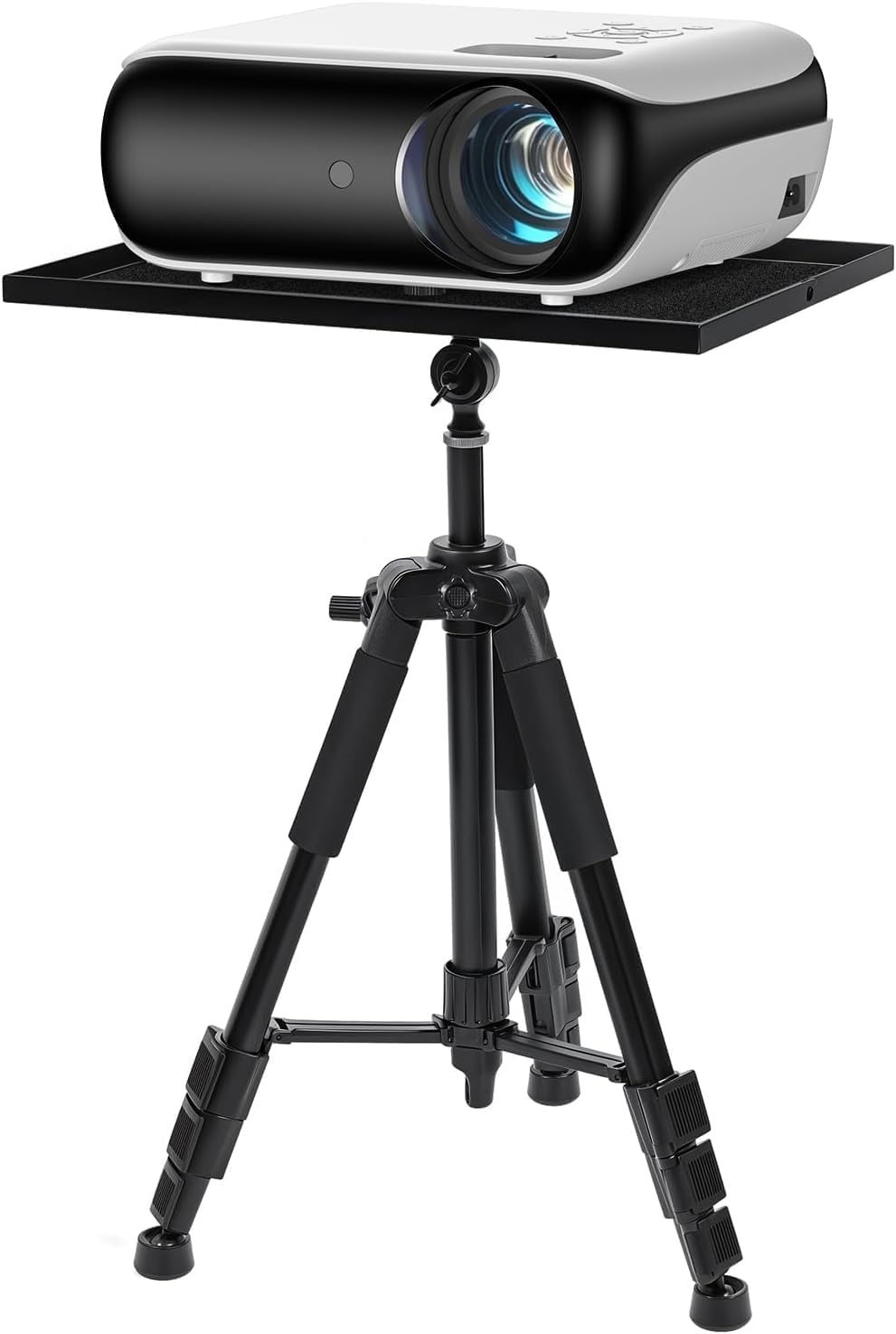 Visit on Amazon → HAPPRUN Native 1080P Outdoor Smart Projector |
Backyard after full dark, camping | Native 1080p, includes a projector stand | 100 to 120 inch, 16:9 | Check current Amazon price |
 Visit on Amazon → Mdbebbron 120 inch Projector Screen |
Indoor and outdoor, any of the above | Foldable, anti-crease, double sided projection | 120 inch, 16:9 | $24.99 |
Read the chart left to right and you will notice something: the screen row pairs with all three projectors, while each projector pairs with one kind of room. That is the whole argument of this guide in a single table. Fix the room, add the screen, then pick the projector your room can support.
Should you buy the XGIMI HORIZON 20?
Buy it if you have a room you can darken and a screen to put the image on. It is the only product here that removes the lamp from the equation entirely, and the 4K claim is the real kind rather than a marketing one. Check current Amazon price and be honest about whether your room earns it. If you cannot control the light, spend the money on curtains first and revisit this one later.
Should you buy the ELEPHAS Roku TV Smart Projector?
Buy it if the goal is a simple, self-contained streaming projector for a dim room. Roku TV built in means one remote and no dongle, and the Bluetooth audio is genuinely useful in a bedroom. It is the budget pick here, and it is honest about what it is. Do not buy it expecting it to survive a wall of windows.
Should you buy the HAPPRUN Native 1080P Outdoor Smart Projector?
Buy it for backyard movies, camping, and anywhere the setup has to be quick and portable. Native 1080p and an included stand are the two features that matter, and both are exactly the kind of thing cheap projectors cut to hit a price. Check current Amazon price. Then wait for full dark.
Should you buy the Mdbebbron 120 inch Projector Screen?
Buy it before you buy a second projector. A screen fixes the thing most people blame their projector for. Foldable, anti-crease, double sided, and 120 inches of 16:9, which is enough for a real movie night and still small enough to store. It is the cheapest meaningful upgrade in a home projector setup, and the one I would buy first if I were starting over with a bare wall and a budget.